Note from AWP: This article is free for everyone.
My family moved to Maryland from our native Pennsylvania when I was ten. They still talked, ate, thought, and lived like Pennsylvanians, most egregiously by tuning in to the weekly Pittsburgh Steelers game while our neighbors grilled hot dogs in Ravens purple. The youngest member of our nuclear family, I became what I now call a “first-generation blue crab picker.” I learned how to eat the steamed crustacean without parental supervision, sitting outside around newspaper-lined tables with real, authentic Marylanders, watching their techniques.
I developed a taste for Old Bay seasoning and snowballs, my new state’s version of shaved, flavored ice served in a Styrofoam cup. As a teenager, I worked summer jobs to save money for Dumser’s Dairyland milkshakes down in Ocean City, where I vacationed like an orphaned stowaway in the rented beach houses of friends’ families who agreed to bring me along.
I didn’t know it at the time, but all of these experiences were making me a writer.
We came to Harford County, forty minutes northeast of Baltimore, just in time for my first day of sixth grade. I needed friends and fast. These teachers hadn’t watched my brother pass through grade school before me as they had in Pennsylvania. Long metal lacrosse sticks didn’t resemble the tape-wrapped hockey sticks I was used to.
Is a writer born when we have our first idea? Send out our first pitch? Receive our first rejection? Our first prize nomination? Or was it those years of middle-school adaptation and survival that made me a writer?
Maybe I carried a bit of my hometown spirit with me, the attitude Pittsburgh poet Jack Gilbert describes as accepting gladness in the “ruthless furnace” of this world. Maybe I learned something, too, from poet Toi Derricotte, a Michigan native who found her academic home at the University of Pittsburgh and once wrote about the paradoxical fear and steadiness of feeling excessive, like being born too unruly for one’s fate. “Nothing could overpower me if I was made of my father’s bones,” she writes.
But I grew into a Marylander, and in 2017, after stops in Tennessee, Utah, North Carolina, and California, I reclaimed my Maryland identity. I moved home to Baltimore in the muggy summer, around the time of the Great American Eclipse. From coast to coast, spectators wearing shiny protective glasses looked up at the sky, some of them so moved they proposed marriage to their partners. Meanwhile, I vowed my commitment to Baltimore, a city that had been gnawing at my imagination since I first left the state for college. I was ready to see what it offered a twenty-eight-year-old who’d bounced around the country and carried a box of scribbled-in poetry notebooks in the back of her car.
.png)
What I found was an embrace: In my first year as a Baltimorean, I joined a welcoming writing group from Meetup.com called The Writing Hour. The group met in a now-defunct backpacker’s hostel located inside an old townhome mansion. The building shared a row with the John H. B. Latrobe House, where, in 1833, a literary committee evaluated a short story for a writing contest called the Saturday Morning Visiter. The author was Edgar Allan Poe, still an unknown writer at the time. Poe won the contest and gained recognition from his contemporaries. The rest, as they say, was history.
“I had chosen to live in a city where defining characters once walked—no, designed—the streets where American stories played out.”
Across the street from that former hostel stands the Baltimore Basilica, designed by Benjamin Henry Latrobe, who also designed the U.S. Capitol. Nothing opens my imagination like proximity to a place where history took physical form, and realizing that meant everywhere in Baltimore, I swelled with excitement. I had chosen to live in a city where defining characters once walked—no, designed—the streets where American stories played out.
I found CityLit Project, a nonprofit arts organization run by the indefatigable Carla Du Pree, an AWP board member, whose leadership skills keep workshops, conferences, panels, and readings alive and accessible in Baltimore to this day. Ms. Carla put me to work planning and spreading the word about numerous annual events, and being a member of her volunteer squad made me feel the warmth of a literary hearth.
I also became involved with Yellow Arrow Publishing, which hosted a monthly First Friday poetry reading in Highlandtown, a lively neighborhood in East Baltimore where you can catch improv shows, eat tasty empanadas, and peruse the shelves at multiple bookstores. Those readings took place inside a ceramic studio run by a man named Dennis, who allowed us to share our stories and poems aloud alongside his clay creations.
Around this time, I met Rafael Alvarez, a longtime Baltimore reporter and consulting writer for HBO’s The Wire. The rumor among creative types was that he would offer any aspiring writer advice if they bought him a hot dog at his favorite diner. Hopefully I’m not misremembering that. I’m still disappointed in myself for being too nervous to take him up on the deal. A Highlandtown native, Alvarez once described Baltimore as the “co-dependent dysfunctional love of [his] life.” He made the choice to resist suburban sprawl, the phenomenon commonly dubbed “white flight” to refer to the generations of people who left the city for a pastoral life in surrounding counties.
“A lot of families . . . moved to the suburbs for a sense of protection. I found it to be terribly boring,” wrote Alvarez. “The city was where things were different, things were alive, people were strange, and as an artist I need that.”
In Baltimore, people are idiosyncratic without trying. You can walk down the street and have a full-on spiritual epiphany with a stranger who compliments your outfit, complains about the weather, then asks for a few bucks to pay for the bus. Without trying, they will share with you insightful observations, like a thought that changes the way you perceive life for the rest of the day, or a piece of advice you didn’t ask for, but annoyingly benefit from. Baltimoreans do this not because we are trying to be interesting or edgy, but simply because that’s the way Baltimoreans are. We couldn’t help ourselves even if we tried.
Maybe this fact explains why so much creative talent comes out of Baltimore—more than most might realize. The city’s Poe obsession has somewhat obfuscated the legacies of other influential writers and creatives, but there are plenty more than the grandfather of the macabre. Perhaps most famously, Frederick Douglass spent his formative years in Baltimore’s Fells Point neighborhood before escaping slavery. An Eastern Shore native, he contributed three autobiographies to the American literary canon. They detail his experiences as a formerly enslaved person. He also wrote revolutionary speeches and fiction. Because Douglass learned to read and write in Baltimore, some say he embraced the city as an adopted home. “My life has been distinguished by two important events, dated about 26 years apart,” Douglass once said in a speech. “One was my running away from Maryland, and the other is my returning to Maryland.”
Other influential Baltimoreans include prize-winning poet Adrienne Rich, born in 1929 and raised in the city. The Jungle author Upton Sinclair came of age as a journalist during the era of the muckraker. And, of course, rapper-poet Tupac Shakur attended the Baltimore School for the Arts before putting out songs that still move listeners with their relevance. Another Pittsburgh transplant like me, Gertrude Stein briefly attended medical school at Johns Hopkins University before fulfilling her fate as an avant-garde writer and artist.
And that just scratches the surface. Today, a number of contemporary creatives and writers also claim Baltimore, whether they live here full-time or just spent formative years here. Ta-Nehisi Coates, who grew up in West Baltimore, has written extensively about how place, family, and history dwell within the collective memory long after one leaves home. His work has helped define a generation’s understanding of race, power, and American identity.
Artist Amy Sherald, famous for painting the portrait of First Lady Michelle Obama, studied at the Maryland Institute College of Art (MICA) and will be showing her mid-career retrospective, American Sublime, at the Baltimore Museum of Art through April 2026, which means you can visit it between panels during the AWP Conference in March.
Actor DeWanda Wise grew up in nearby Woodlawn and has collaborated with some of today’s finest filmmakers, including the legendary Spike Lee. Poet and Baltimore native Unique Robinson infuses her collections with love for the city she grew up in, while documenting its infrastructure gaps through a journalistic lens. Author and Goucher College graduate Kristina Gaddy collaborates often with Grammy Award–winning MacArthur recipient Rhiannon Giddens to tell the historically accurate story of the American banjo, which was first sold commercially in Baltimore.
Living in Baltimore often feels like living in America’s backyard, a place where people define themselves less by their schmoozy nine-to-five jobs and more by our values. We care more about the friendships we keep, or perhaps more accurately the newspaper-lined tables we pick crabs around, and the quality of life we are living. Some worry this approachable atmosphere will subordinate us to glitzier metropolitans like Washington, DC, where people are more likely to introduce themselves with a firm handshake and job title. But strike up a conversation with us. No job titles required. Just stories.
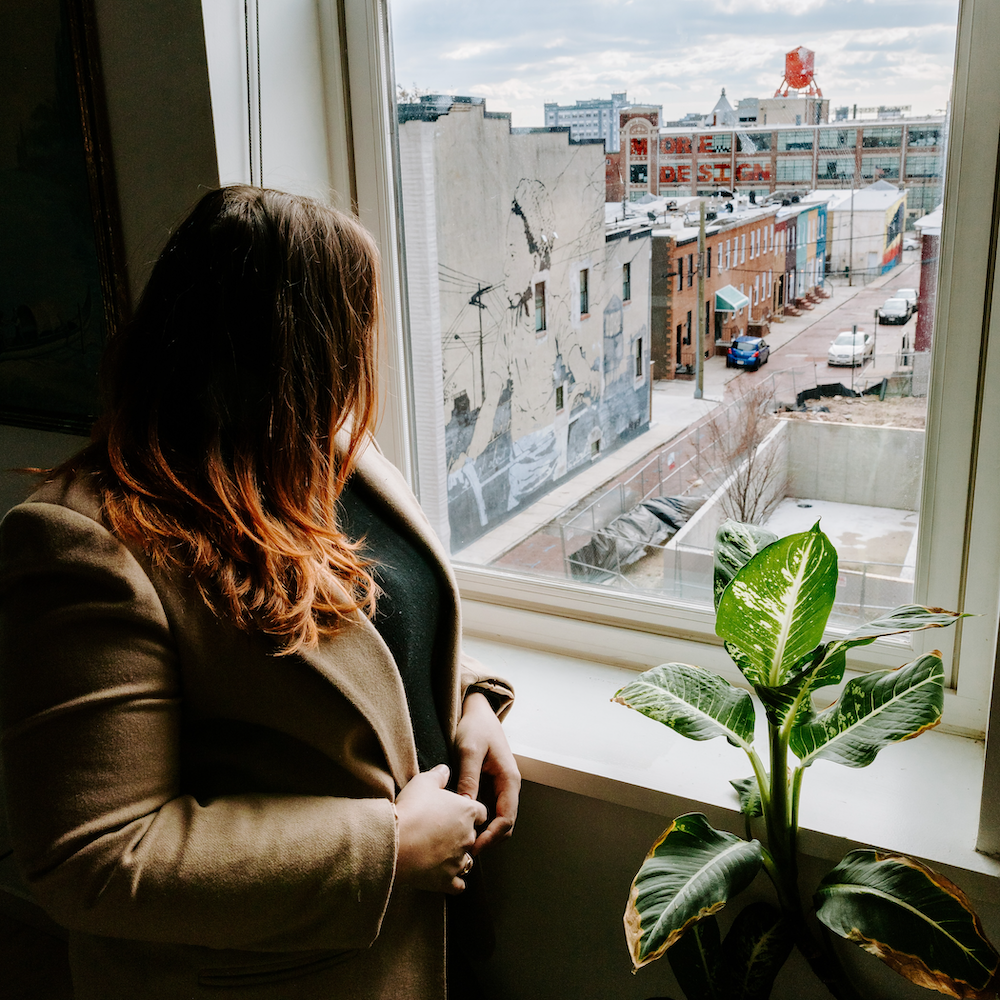
Photo credit: Alicia Wiley
You might have noticed my use of we when describing Baltimoreans. I must confess that I haven’t lived in Baltimore continuously since I first returned in 2017. In 2020, the career gods delivered me a plot twist before I could settle down for good. At the start of the pandemic, I received an invitation to move to New York City for a writing job, interviewing money experts and publishing their advice in articles for a new website launched by CNBC.
Would I be just like the generations of people before me who had abandoned Baltimore for promises elsewhere? A friend later told me that she bet yes, that I would fall in love with New York and never return. And while I did love my time there, and still dream of one day having a pied-à-terre in the West Village, I missed Baltimore often. Too often.
Working in New York media gave me the perspective of scale. People say everything is bigger in Texas—no, everything is bigger in New York media. I went from pushing the “publish” button to an email list of a few hundred people at the various nonprofit jobs I had held, to being one click away from reaching hundreds of millions. I had a front-row seat to the machinery of mainstream media, and to my surprise, I succeeded by most measurable standards. The headlines I wrote broke traffic records. Millions of people read my team’s stories, and I seemed to have a knack for pitching ideas that resonated with American readers—where was I coming up with them, my editors wanted to know?
Here, I must credit my editor’s intuition to the fact that I have been heavily influenced by Baltimore—and, fine, by my Pittsburgh upbringing too. How else could I so naturally keep a finger on the pulse of topics people cared about? Did I begin developing this skill during those early years of adapting to my new state, being the new kid in a new town? If so, the skill also came from the culture and the people. Some say Maryland is part Southern charm, part Northern industrialism. We have a work ethic, but also an ability to small talk with folks in the checkout line as though there’s nowhere else better to be, unlike in Manhattan, where people rush between subway stops and high-rises.
“Baltimore was my home during those days I put my head down and wrote every day, waiting for the world to tell me I was a writer.”
It’s hard to know how much cities shape us until we’ve left them. In my case, until we’ve left, come back, and left again. In 2025, I returned again. While my career-defining break came in New York, the media mecca of all cities, it was Baltimore that held me during the tenuous years before the world saw me as a writer, the way I had always seen myself. Baltimore was my community when every day I asked myself if I was crazy, if the dream I’d funded with student loans and teaching gigs would actually pay off. Or the scarier question: Was I any good? Baltimore was my home during those days I put my head down and wrote every day, waiting for the world to tell me I was a writer.
Shortly after returning in 2025, I sat at the tip of South Ann Street in Fells Point, looking out onto the brackish Patapsco, one of the Chesapeake Bay’s main tributaries, named after the Algonquian word for “backwater.” In college, I’d driven back and forth from Maryland to Tennessee enough times to pass signs alerting me each time I entered and exited the Chesapeake Bay watershed, a massive estuary network covering an impressive sixty-four thousand square miles between upstate New York and southern Virginia. Now, as a Baltimorean, I could reside in it, I thought. I could be part of its living entity, an enjoyer and preserver of its marshy basins and tidewaters.
Many years earlier, I witnessed a man wiggling around on his belly near Henderson’s Wharf Marina, just a short walk away from my perch where I sat. I recall him squirming along the red brick pathway, reaching a net out toward a wooden dock where two blue crabs clung to a piling. He timed his capture with the wake of a passing ship. When the water level fell, he scooped the creatures up and swished them back to shore. Curious, I watched him plop them into a red milk crate full of shiny wet pinchers. When I asked him what he planned to do with his catch, he said he would sell them out of the back of his pickup truck.
Then and there, I wrote a poem. I reached for words to describe the love I felt for the industrial waterway, its “brindled,” “oily” waters reflecting the sun’s sheen. “Gasoline made sparkling,” I gushed, feeling at once mournful and accepting of the horrifying intimacy with which nature mirrors back to us the effects of human behavior. Baltimore locals know that industry has failed the Patapsco. It’s been a longtime dumping ground for factory wastewater, industrial spills, and trash.
As I wrote my way into familiarity with the body of water I now wanted to call home, I felt the desire to both clean her up and celebrate her, in all her polluted glory. Ready to trade my adventure-seeking decades of old for an experience of finally belonging. I wanted to learn about the waterways that surrounded me as a child, the ones responsible for spawning the crabs I gobbled up as I became a Marylander. I wanted to accept a place for all that it is, this place that had accepted me.
Today, a group of brave Baltimoreans swim in the Patapsco. The city held a “Harbor Splash” event in 2024 to celebrate the improved health of our industrial river. I suppose a lot has changed since 2017, when I first arrived during that eclipse summer, and after writing that poem praising the city’s murky water. Now that I’m back—presumably this time for good—I wonder if I can learn to dive into the metaphorical waters of the community that held me all those years ago with the eagerness of someone diving into the Patapsco. Can I also take responsibility for the environment here, to protect it and advocate for it, the way charming postindustrial towns deserve? Can I learn to give back, the way the city has always given to me?
Megan DeMatteo is a nationally published journalist, travel writer, and digital creator, and is one of the thirty inaugural Yahoo Creators. She is the founder and CEO of Unimaginably Good Media, where she has transformed a successful freelance career into a thriving editorial consulting practice. Her work appears in Fodor’s Travel, Dwell, Marie Claire, Insider, and more, following an earlier career in personal finance journalism. DeMatteo’s debut self-help book will be published by Broadleaf Books in 2026.