For over a decade, I’ve called Johns Hopkins University, its department of creative writing, and the city of Baltimore home, and I get to rediscover home through fresh eyes with the arrival of each new cohort of students. “Discovery” is a word we hear a lot around here, and rightly so. Founded 150 years ago as the nation’s first research university, Johns Hopkins is all about discovery. While many of the discoveries here at JHU are the lifesaving or cosmos-expanding scientific kind made by microscope or telescope, the institution’s long-standing commitment to independent and original thought makes terrifically fertile ground for creative exploration and discovery in the literary arts as well. This milestone sesquicentennial year, we’re all doing a lot of reflecting on Hopkins history, and we’re taking inspiration from that history to think about our future. My department, the Writing Seminars, is the second-oldest degree-granting creative writing program in the country, founded by Elliott Coleman in 1947. Postmodernist trailblazer John Barth was one of its first graduates, and later one of its most beloved and iconic professors. Last year’s Alumni Weekend memorial for Barth was an opportunity for Hopkins past and present to connect with each other. Rome Prize–winning novelist Gina Apostol and other literary luminaries embraced old classmates and reminisced about Jack (as those close to Barth called him) at the reception, and the president of PEN America, Jennifer Finney Boylan, brought down the house from the podium when she delivered a poem—equal parts funny and moving—in which the department and community became “The House That Jack Built.” (Barth, for his part, gave credit to Coleman: “I have admired Elliott Coleman’s short poems and his long poems; most of all I admire his longest-running poem: the Johns Hopkins Writing Seminars, over which his benignant spirit still very much presides.”)
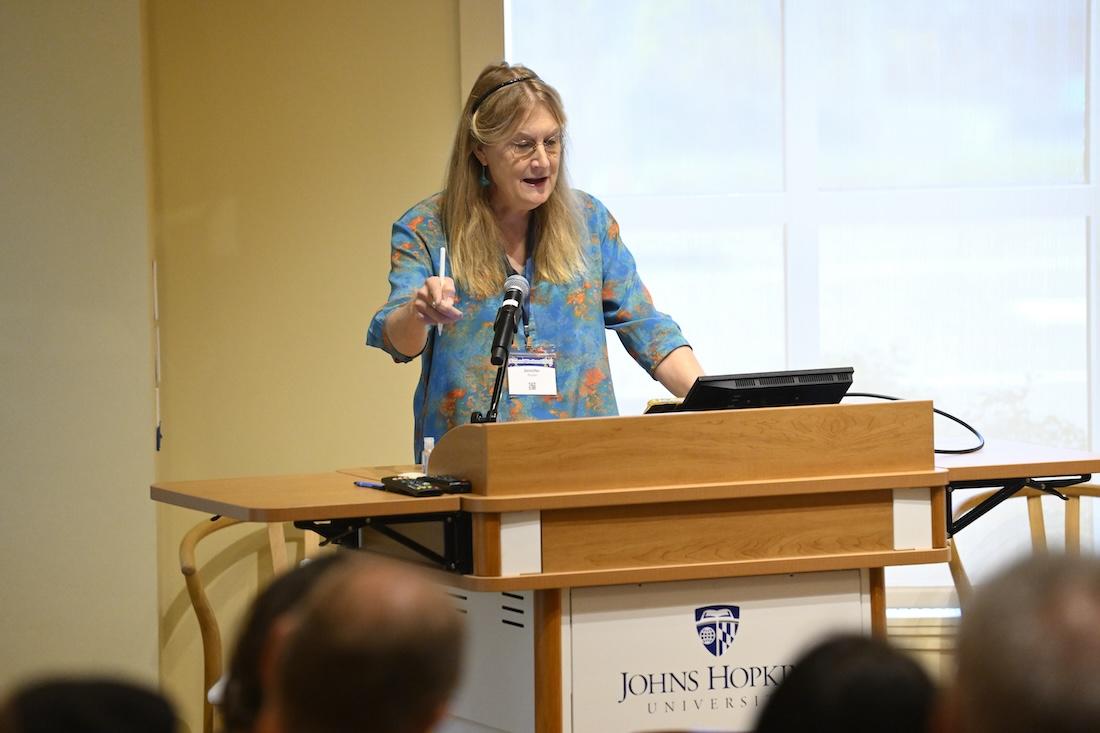
Johns Hopkins University alumna and PEN America President Jennifer Finney Boylan celebrates Hopkins alumnus and professor emeritus John Barth at his 2025 memorial. Photo credit: Will Kirk / Johns Hopkins University, 2025
Apostol and Boylan are just a few of the many noteworthy graduates of the Writing Sems (as its students call it), including Gil Scott-Heron, Russell Baker, Rosanna Warren, Louise Erdrich, Heid E. Erdrich, Elin Hilderbrand, Chimamanda Ngozi Adichie, Porochista Khakpour, Richie Hofmann—the list goes on and on, including winners of the Pulitzer Prize, the MacArthur “Genius” Award, the National Book Award, the National Book Critics Circle Award, and countless other honors. The Writing Seminars department celebrates its eightieth anniversary in 2027—another milestone that invites our community to pause and look back, while our more recent graduates continue to inspire excitement about the future as well, with stunning fiction and poetry debuts from Em North (In Universes), Amanda Gunn (Things I Didn’t Do with This Body), Jenny Xie (Holding Pattern), Armen Davoudian (The Palace of Forty Pillars), and so many others over the past few years. Where the students of yesterday worked with Barth, Coleman, and other memorable writers, the students of today work with a powerhouse faculty that includes my colleagues Susan Choi, Eric Puchner, Danielle Evans, Lysley Tenorio, Lauren Russell, Andrew Motion, and more. For our MFA students, the workshop experience is complemented by professional experience teaching undergraduate courses and editing The Hopkins Review, incredible readings by world-class visiting writers, such as Zadie Smith and Salman Rushdie, and community engagement through Writers in Baltimore Schools and other organizations and initiatives.
Our department’s residential MFA and BA programs focused on poetry and fiction are part of a broad and vibrant literary ecosystem at Hopkins, with numerous opportunities for writers at all points in their writing life. The JHU Odyssey program’s lifelong learning offerings include the newly launched Moser Family Writer in Residence initiative, which brings a renewed emphasis on the literary arts through online courses, engaging lectures, and immersive, place-based experiences. The JHU MA in Writing and MA in Science Writing programs are flexible online degrees with the option to incorporate summer residency experiences; their graduates include bestselling authors Nicole Chung and Molly Caldwell Crosby. The journal Tendon centers literary and visual arts in the health humanities; Hopkins Press, America’s oldest university press, publishes a vast array of scholarly and literary books and journals; the Departments of English, Modern Languages and Literature, and Comparative Thought and Literature all champion the literary arts through world-class scholarship; the Alexander Grass Humanities Institute brings conversations around literature to a broad public; and the Sheridan Libraries is a treasure trove of literary special collections and archival materials. The literary offerings proliferate off campus as well, with myriad independent bookstores, public libraries, reading series, book festivals, and community organizations dedicated to writing, performance, and expression.
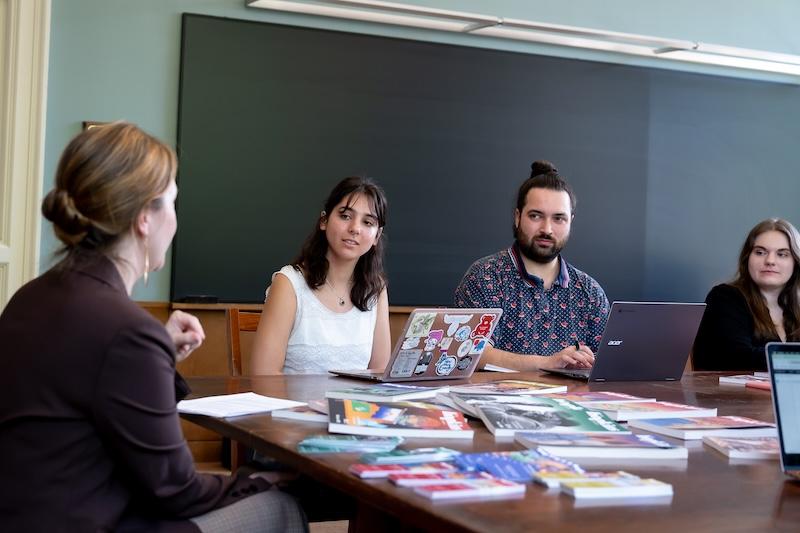
The Hopkins Review editorial team of MFA and BA students meets in the John T. Irwin Seminar Room to discuss submissions. Photo credit: Larry Canner / Johns Hopkins University, 2025
Just last year, Johns Hopkins extended its commitment to the arts with a milestone that itself will be cause for celebration in the years to come—the establishment of an Office of the Arts, one of the exciting outcomes of the Provost’s recent Taskforce on the Arts. The task force’s report offered a unifying vision for the future of the arts at JHU, including the arts as a core element of institutional identity and practice. The literary arts are vital to this vision, and Hopkins students—and emerging writers—of today and tomorrow will both benefit from and contribute to that vision.
As I read applications to our MFA program this winter, I am struck again by the spirit of discovery and the use of language as exploration and creation—thrilled to read work entirely new to me and wowed by other writers’ words. I can’t wait to return this favor of inspiration to future students, whether that means recommending the work of a local poet I think they’ll love, or a great lecture series, or an only-in-Baltimore tradition, or an opportunity to collaborate or publish—ways for each of us here at Johns Hopkins University to feel at home in discovery and discover a home.
Dora Malech is a professor at Johns Hopkins University, where she is chair of the Writing Seminars and editor in chief of The Hopkins Review. Her latest book of poetry, Trying × Trying, was published by Carnegie Mellon University Press in 2025. Previous books of poetry include Flourish, Stet, Say So, and Shore Ordered Ocean; her poems appear in publications that include The New Yorker and The Best American Poetry. She is coeditor of The American Sonnet: An Anthology of Poems and Essay and cotranslator of Dolore Minimo by Giovanna Cristina Vivinetto. She is the recipient of honors that include an Amy Clampitt Residency Award, a Ruth Lilly Poetry Fellowship, a Mary Sawyers Baker Prize, and a Writing Residency Fellowship from the Civitella Ranieri Foundation. In May 2026, she will colead the Policromia Poetry Workshop at the Siena Art Institute.