The lives of writers have long been romanticized by the rest of the world. Hemingway in a Parisian café. Austen at her desk in the sitting room.
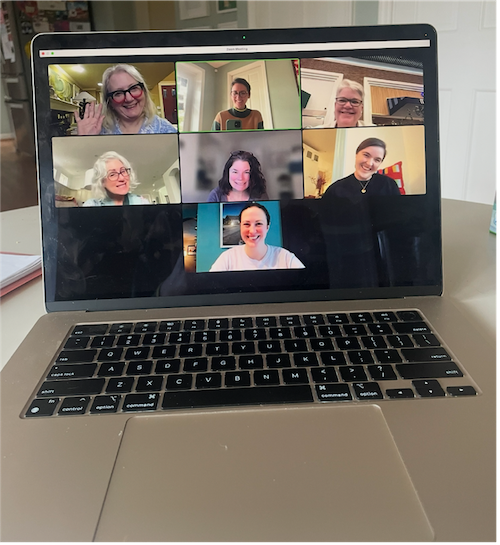
Photo credit: Abbie Rudibaugh
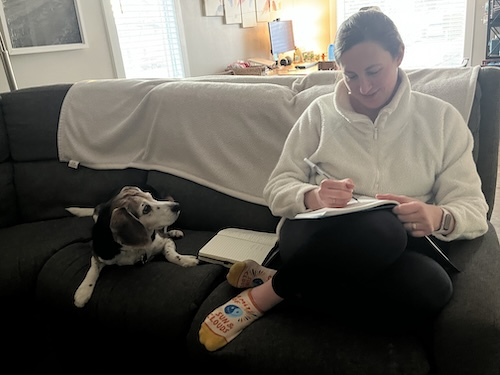
My life, I think, doesn’t lend to glamorization: Costco runs in yoga pants; zipping across town in my minivan to get my daughter to gymnastics on time. My writing life is equally unglamorous: Loungewear is involved, as are couch cushions and the lethargic beagle who sleeps beside me. I tap away at laptop keys, fueled by self-doubt and caffeine. I neglect to shower or consume enough protein. I write when I can. I write in the small cracks each day offers.
But every week, for ninety minutes, I feel like a real Writer. It happens at 10:30 Eastern time on Thursday mornings. It happens when I click Join and enter a Zoom room with three to eight fellow poets who all study (or have studied) in the Sena Jeter Naslund-Karen Mann Graduate School of Writing at Spalding University.
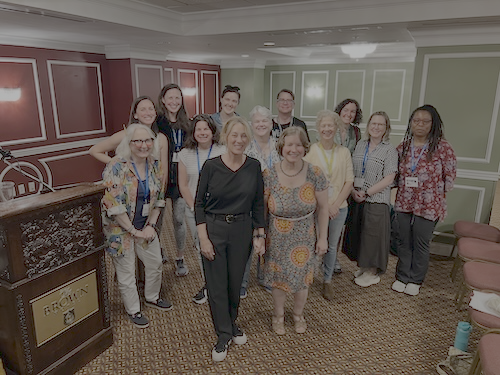
During that time, we hunch over our desks, writing poems and responding to one another’s work in real time. We’ve been doing this faithfully since the summer of 2023 when several alumnae and current students organized the practice and were gifted a recurring Zoom link from Spalding.
As a current MFA poetry student, our weekly practice has helped ensure I am keeping up with the demands of my independent study; I am required to submit a collection of new work every six weeks or so throughout each semester. It’s so helpful to have built-in accountability with this extracurricular group—people who text me if I skip too many Zoom sessions to make sure I’m still writing. This feels particularly important for students (like me) in a low-residency program.
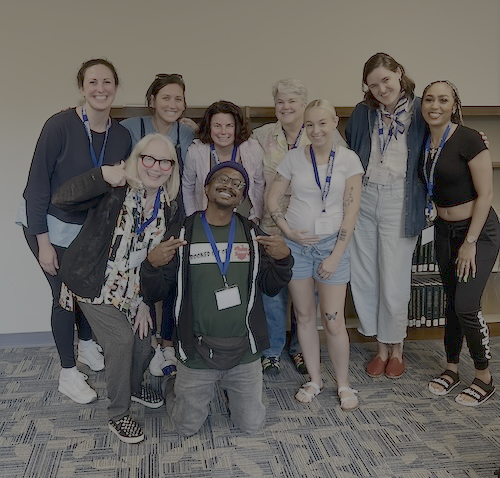
What’s even better: This practice encourages us to follow up with one another in the days following our Thursday meetings. Messages hit the group text that say things like, I revised! You want to take a look? followed by screenshots of the poems we’ve revised. These quick, emoji-laden exchanges also help in the weeks between receiving formal feedback from our respective MFA mentors. They make me feel better prepared to send work to my faculty mentor, and out into the world as well.
A typical session goes like this: A leader (we rotate) chooses a poem to read aloud. The leader then offers half a dozen writing prompts. The urge to catch up about our lives is pushed to the side. We turn off our microphones and cameras and—for thirty minutes—we sit at our respective desks, writing.
The group is inclusive and open to new members. There is no need to RSVP. You come if you can. You come in your pajamas, if you want. You can come with puffy eyes or a distracting work deadline hindering your creativity. You can come and expect no judgment, only acceptance and encouragement. Maybe because the stakes are low (no one expects genius in the time it takes to deliver a pizza), we all usually manage to write something.
After thirty minutes, we reunite to share our pieces. Half an hour isn’t enough time to write a poem, really, but more often than not, we have ideas that can be expanded later, or the first stanza of something that’s got legs. We weigh in on one another’s work with feedback. Most importantly, I think, we articulate how we connect with each newly drafted poem.
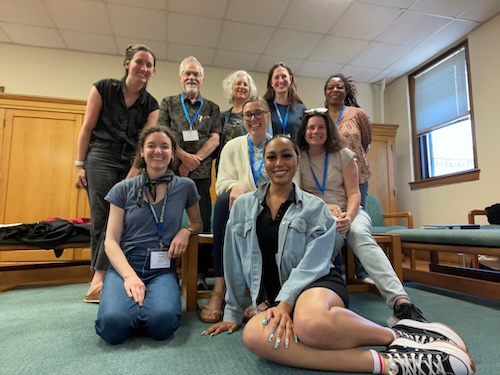
Because each poet in the circle has studied in Spalding’s Naslund-Mann School, we’re all speaking the same language when it comes to giving feedback. We’ve all been through multiple rounds of workshop—the heart of each residency—so we are accustomed to hearing what landed with others and what was unclear. We’re quick to lift each other up with praise, but not unduly shy about articulating what didn’t resonate, and why. This is invaluable. Giving feedback on someone else’s writing can be difficult, yet it’s essential for the writer to hear how something is read by another human. We need one another to take our blinders off. It’s a gesture of love and an exchange of trust. It takes time to build this ability to be vulnerable with one another with our writing, and effort to foster it.
One thing that helps, too, is the water we’re all swimming in. Meaning, because our writing program does not cultivate a competitive climate, there’s no sense that there is a best poet or a best poem. Rather, we are comparing our work to that of our prior selves. As the program’s cofounder Sena Jeter Naslund famously iterated, our only real competition is in the library.
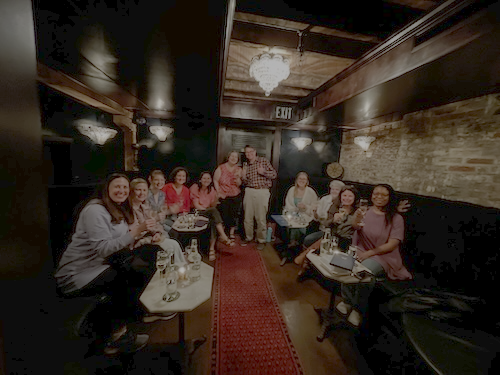
Being a part of this weekly Poet’s Circle has meant everything for my writing practice. One hope I had for enrolling in a low-residency MFA program was finding a home as a writer. Because I knew not to expect the same heady intensity of undergrad days (living with roommates, being with classmates daily, etc.), I was worried I wouldn’t find it. I should not have worried. Partly because this low-residency program values flexibility, the members of my Poet’s Circle will complete the program (or have completed the program) at different times. This is also not an obstacle. The circle we’ve created is a solid landing place for all of us as peers and as alums. The Naslund-Mann School has an active and vibrant alum community, and I think this weekly Poet’s Circle is part of that.
As adults with busy lives and myriad commitments, it is more challenging to prioritize community. However, I’m grateful and thankful for our circle of Spalding poets—old and new—and I’m excited to see where the years will take us.
Colleen Alles is a native Michigander and award-winning writer living in Grand Rapids. The author of three novels and two poetry collections, she’s also a fiction editor with Barren Magazine and an MFA candidate at Spalding University. Her debut short fiction collection, Close to a Flame (Cornerstone Press), was a 2025 National Indie Excellence Awards finalist; it was also named one of Lit Hub’s “100 Notable Small Press Books of 2025.” You can find her online at ColleenAlles.com.