When I was matched in the Writer to Writer program in 2022, I’d been trying to compile a poetry collection for a few years. “Compile” is really the right word. The manuscript I brought to my mentor, Claire Wahmanholm, was more of a portfolio, in which I tried to faithfully represent the last twenty years of my poetic development. Intellectually, I understood that other poetry collections weren’t comprehensive or documentary. But emotionally, it was difficult for me to chart a middle path between the comprehensive and the tightly themed (books like Brittney Corrigan’s Daughters or Terrance Hayes’s American Sonnets for My Past and Future Assassin). I knew the latter model wouldn’t work for what I had, and at almost forty, I wanted to work with what I had.
I didn’t even know what questions to ask to get there. Thankfully, Claire did. In our initial meetings, she voiced that there were a lot of themes, people, directions, and ideas in my original manuscript—a kinder way of describing a kitchen sink. Together, we identified the themes of language and lineage that I cared about most, and that the strongest poems embodied, and began reshaping a book around those themes. Documentary compulsions still tugged at me—for example, as Claire made suggestions for reordering poems, I’d say something like “Well, that poem is about Person A, so it should go with the other one about them.” And she would say something like “But no one’s going to know they’re both about the same person unless it’s in the text,” which of course, of course, but I needed to hear it. I needed to hear that my own brain was not a useful organizing principle for a book that would have readers other than me. I reluctantly cut older poems that I loved, thinking they’d be too “old” to publish later. I’m realizing now that the pain of this reluctance stemmed in part from a fear that this could be my only opportunity to publish a book. If a publisher was going to take a chance on a middle-aged, non-MFA-holding poet, I’d better get everything in there before my poems’—or my—expiration date. But Claire helped me understand that the poems that didn’t make it in will find other homes, whether in a journal or (knock on wood) my fifth book.
By the end of the Writer to Writer mentorship, Claire had helped me take my book from fifty-four to thirty-eight poems, and from six to four sections. The sections’ titles were no longer disconnected from each other, but tied together in the theme of language: Etymology, Silent Letters, Contractions, and Common Language (the last a nod to Adrienne Rich, whose poems I draw from in a cento that opens the last section). Now, I could describe the book’s arc in a paragraph to publishers when I submitted it. After several rounds of rejection, Law of the Letter won the Hillary Gravendyk Prize and was published by Inlandia Books this spring. As readers, reviewers, and interviewers have begun talking with me about it, they’ve noted the progression and movement in the book, the unfolding of new understandings and contexts. I’m so grateful to Claire Wahmanholm and to the Writer to Writer program for the time, space, and labor it took to put my first book together; Law of the Letter would not be in the world without either of them.
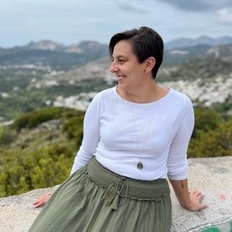 Elizabeth Galoozis’s debut full-length collection, Law of the Letter (2025), won the Hillary Gravendyk Prize from the Inlandia Institute. Her poems have appeared in Air/Light, Pidgeonholes, RHINO, Witness, Sinister Wisdom, and elsewhere. She serves as a reader for The Maine Review and has been nominated for two Pushcart Prizes and for Best of the Net. Galoozis was selected by Claire Wahmanholm for the AWP Writer to Writer Program in 2022. She works as a librarian and lives in Southern California. Galoozis can be found on Instagram and Bluesky at @thisamericanliz, and at her website, ElizabethGaloozis.com.